From artificial intelligence and digital finance to Central Asia’s first air taxi demonstration, Alatau City is developing an integrated regulatory sandbox designed to test innovations, attract international partners and support the emergence of new industries.
Kazakhstan is taking a new approach to urban and economic development through Alatau City, a project designed to bring together modern infrastructure, advanced technologies, investment and a special legal framework within a single urban environment.
Unlike conventional cities, where digital solutions are often introduced into existing infrastructure, Alatau City offers an opportunity to integrate technology into the city’s development from the outset.
Artificial intelligence, digital twins, tokenized assets and urban air mobility are therefore being developed not as isolated initiatives, but as interconnected components of a broader innovation ecosystem.
At the center of this approach is a regulatory sandbox: an experimental environment where emerging technologies and business models can be tested, refined and progressively introduced into practical use.
A Regulatory Sandbox for a New Economy
The regulatory sandbox concept is central to Alatau City’s development model. It aims to create conditions in which businesses, technology developers, investors and public institutions can explore innovative solutions within a defined regulatory framework.
The legal foundation was established by the Constitutional Law of the Republic of Kazakhstan “On the Special Legal Regime of Alatau City”, signed by the President on May 8, 2026.
The law provides a framework for special regulatory arrangements and experimental mechanisms supporting innovation, investment and the development of new economic activities.
Alatau City’s regulatory sandbox is currently taking shape, with individual technological initiatives already progressing through demonstrations, international partnerships and preparations for pilot implementation.
Its distinguishing feature is the ambition to bring together artificial intelligence, digital infrastructure, digital finance, advanced mobility and regulatory innovation within a single urban ecosystem.
For technology companies, this creates opportunities to explore real-world applications. For investors, it offers a potential platform for participation in emerging industries. For Kazakhstan, it provides an opportunity to develop practical experience in introducing new technologies and shaping the conditions for their wider adoption.
Artificial Intelligence and Digital Twins: Building a Data-Driven City
Artificial intelligence is expected to play an important role in Alatau City’s future urban management model.
Rather than treating AI as a standalone technological feature, the city aims to incorporate data-driven solutions into infrastructure planning, utility management, transport systems, energy efficiency and urban services.
A key component of this approach is the development of a Digital Twin, a virtual representation of the urban environment that can integrate spatial information, infrastructure data and analytical tools.
As the city develops, such a platform could help simulate urban scenarios, monitor infrastructure, forecast demand and support more informed planning and operational decisions.
In September 2026, Alatau City Authority signed a memorandum of understanding with South Korean companies AST Holdings and ILJOO GnS to explore cooperation in Smart City technologies and the development of a Digital Twin pilot.
The proposed cooperation includes examining opportunities to collect, synchronize and analyze infrastructure data through Internet of Things technologies.
Further cooperation in digital transformation was established with Huawei Technologies Kazakhstan during AI & Digital Bridge 2026.
The agreement covers areas including artificial intelligence, Smart City solutions, cloud technologies, data centers and digital platforms.
Together, these partnerships support Alatau City’s ambition to develop a digital infrastructure capable of evolving alongside its physical construction.
The broader objective is to establish a city in which technology contributes to operational efficiency, economic productivity and the quality of urban services.
Central Asia’s First Air Taxi Demonstration
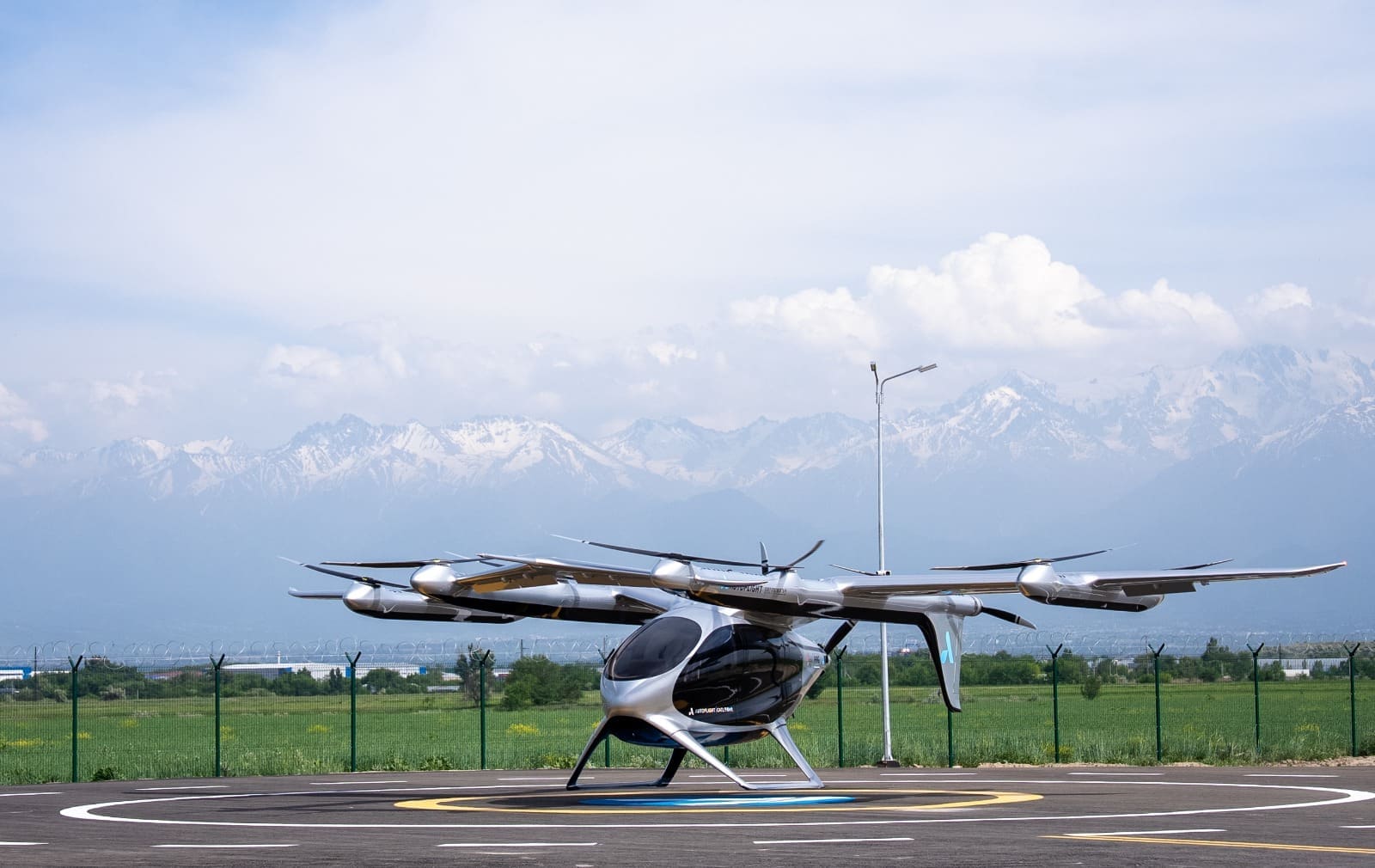
One of the most visible examples of Alatau City’s emerging innovation ecosystem took place on May 19, 2026, when the city hosted Central Asia’s first demonstration flight of an electric vertical take-off and landing aircraft (eVTOL).
The demonstration, supported by Kazakhstan’s Ministry of Artificial Intelligence and Digital Development, featured the AutoFlight Prosperity aircraft, designed to accommodate one pilot and five passengers.
The flight was conducted without passengers, with safety considerations taking priority.
The initiative is being developed by the Kazakhstan-based private company Alatau Advance Air Group Ltd. (AAAG), together with international technology partners.
The event also showcased unmanned cargo delivery technologies and digital solutions for urban air traffic management.
The significance of the demonstration extends well beyond the aircraft itself.
Urban Air Mobility (UAM) requires an integrated ecosystem of aviation infrastructure, digital navigation, traffic management, operating procedures, maintenance capabilities and regulatory arrangements.
Alatau City is exploring how these elements can be developed together as part of its broader urban and technological infrastructure.
Work has also begun on the city’s first vertiport, intended to support the future development of urban air mobility.
In September 2026, cooperation between Kazakhstan and South Korean partners expanded to include technologies for unmanned traffic management, knowledge transfer and the development of solutions that could be adapted for application in Kazakhstan.
The air taxi demonstration represents an early practical step toward exploring a new category of urban transport and logistics services.
It does not yet constitute the launch of regular commercial passenger operations, but it demonstrates the potential for Alatau City to serve as a platform for testing technologies that could eventually contribute to new industries.
Digital Finance and Tokenization: New Opportunities for Investment
Alatau City’s innovation agenda also extends to digital finance, tokenization and emerging investment mechanisms.
As Kazakhstan develops its digital economy, Alatau City is exploring how modern financial technologies could support investment, business activity and the financing of urban infrastructure.
In September 2026, Alatau City Authority, South Korea’s Dunamu, the operator of the Upbit digital asset platform, and Alatau City Bank signed a memorandum of understanding covering cooperation in digital finance, real-world asset tokenization and related infrastructure.
Additional partnerships were established during AI & Digital Bridge 2026 with the Kazakhstan Stock Exchange (KASE), Binance Kazakhstan and Bybit Kazakhstan.
Cooperation with KASE includes exploring the concept of the Alatau Token Exchange, a proposed platform for the issuance, circulation and trading of tokenized assets, alongside the development of digital financial instruments.
The memoranda with Binance Kazakhstan and Bybit Kazakhstan focus on examining opportunities related to real-world asset tokenization, digital payments, cross-border transfers and settlement mechanisms.
These initiatives could broaden the range of financial tools available to businesses and investors participating in Alatau City’s development.
Potential applications include infrastructure projects, industrial facilities, logistics assets and commercial real estate.
The agreements establish a basis for further cooperation and project development. Specific products and services will be introduced as the necessary technological, commercial and regulatory conditions are established.
One Innovation Ecosystem, Multiple Applications
Artificial intelligence, digital twins, urban air mobility and digital finance serve different purposes. Within Alatau City’s development model, however, they are intended to complement one another.
Digital infrastructure provides the foundation for collecting and processing information. Artificial intelligence can turn that information into insights for urban planning and management. Advanced mobility solutions may introduce new transport and logistics services. Digital financial technologies can expand opportunities for financing projects and connecting businesses with capital.
The special legal regime provides a framework for exploring these innovations and developing appropriate conditions for their application.
This integrated approach is particularly relevant to a city being developed from the ground up.
It creates opportunities to consider technology, infrastructure, regulation and economic activity as connected elements of a single development strategy.
The Role of Alatau City Authority
Alatau City Authority plays a coordinating role in the city’s development, bringing together public institutions, investors, technology companies and international partners.
Within its mandate, ACA works to establish the institutional conditions needed to advance projects, develop partnerships and support the practical implementation of the city’s special legal framework.
In the field of innovation, this involves helping technological initiatives progress from initial proposals and demonstrations toward pilot projects and, ultimately, practical applications.
International cooperation is an important part of this process.
Partnerships established through business forums, official meetings and international roadshows provide opportunities for knowledge exchange, technology transfer, joint project development and investment engagement.
The objective is to move beyond individual announcements and establish a sustained framework for technological and economic cooperation.
From Experimentation to Economic Opportunity
Alatau City’s development illustrates how Kazakhstan is seeking to connect urban planning with technological innovation and economic diversification.
The regulatory sandbox is still evolving, and the initiatives within it are at different stages of maturity.
Some technologies have already been demonstrated publicly. Others are progressing through feasibility assessments, partnership development, pilot preparation or regulatory planning.
This phased approach reflects the complexity of introducing new technologies into real urban environments.
Over time, practical experience gained in Alatau City could help inform regulatory approaches, support the development of new business models and create opportunities for wider adoption of successful solutions across Kazakhstan.
The broader ambition is not simply to build a technologically advanced city, but to establish an environment in which innovation can translate into investment, economic activity and improved urban services.
Through Alatau City, Kazakhstan is creating a platform where emerging technologies, international partnerships and new regulatory approaches can come together to shape the next generation of urban and economic development.