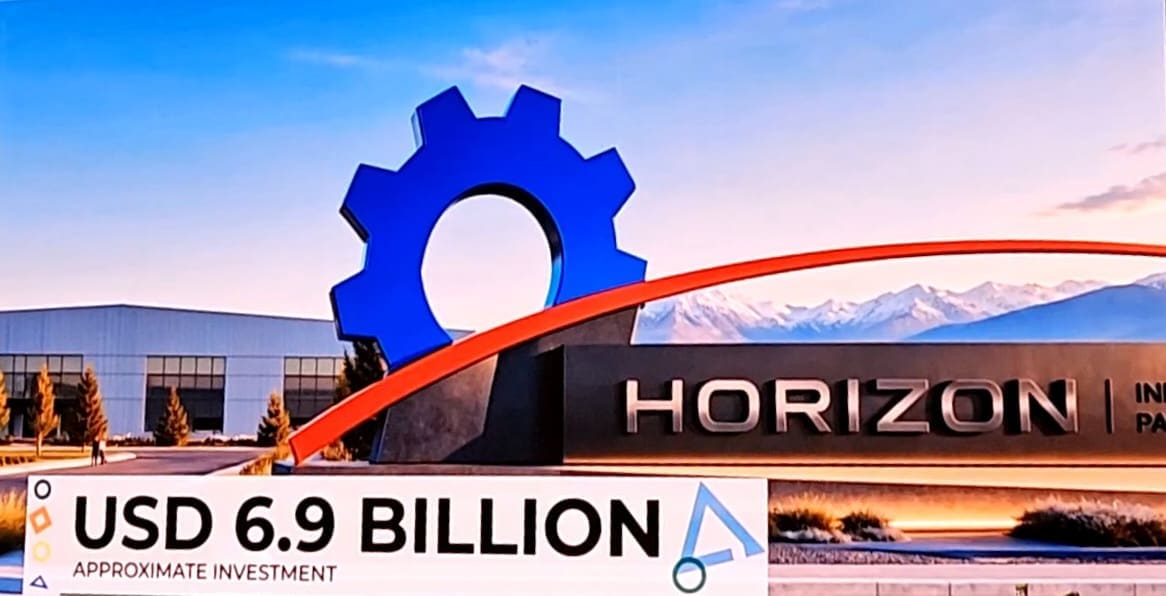
Central Asia is repositioning itself as a global logistics and industrial hub: at a high-profile roadshow in Berlin, the Deputy Prime Minister of the Republic of Kazakhstan, Kanat Bozumbayev, accompanied by Ambassador H.E. Dr. Nurlan Onzhanov, presented the visionary master plan for Alatau City. The far-reaching special laws of the planned 88,000-hectare megacity were discussed before representatives of German business. NewsMark attended the exclusive event in the conference hall.
Exclusive report (Part 1) by our NewsMark Central Asia expert Christian Grosse
Strategic dialogue and a new partner on an equal footing
The importance that Germany's industry and business associations attach to Central Asia's economic development was already reflected in the high-calibre opening of the Berlin roadshow. Wolfgang Niedermark, member of the Executive Board of the Federation of German Industries (BDI), opened the event and, in his welcoming address, underlined German companies' profound strategic interest in a substantial expansion of the bilateral dialogue. Niedermark highlighted the immense potential of Eurasian cooperation and stressed a fundamental paradigm shift: in the eyes of German industry, Kazakhstan has long since evolved from a mere importer and exporter of raw materials into a technologically sophisticated partner. The goal of German business is therefore decidedly to deepen cooperation in industrial value creation, to interlink supply chains more closely and to massively intensify technological cooperation in the course of this forward-looking megaproject.
Anyone in the hall following Niedermark's remarks could sense that the pronounced, pragmatic "can-do spirit" currently shaping Kazakhstan's economic and administrative dynamism can also serve as a model for Europe. Major projects and infrastructure milestones are being delivered there with remarkable determination and speed of implementation. In this context, Niedermark remarked critically, in front of the invited guests, that this dynamic "can-do spirit" now seems to have been lost in Germany. He stressed that German business, given its own lengthy planning and approval processes, can hopefully contribute actively to the project and learn from Kazakhstan's modern pace of innovation and implementation.
The concept from the hand of Kazakhstan's state leadership
Under the professional moderation of Jens Böhlmann, Head of the SME Contact Point at the German Eastern Business Association (Ost-Ausschuss der Deutschen Wirtschaft), a structured presentation unfolded that gave us in the hall a concise, visual picture of the undertaking. After a short concept film, Deputy Prime Minister Kanat Bozumbayev took the floor. In his remarks, Bozumbayev focused on the strategic significance of the project and on the constitutionally guaranteed special legal regime, which grants foreign players unprecedented latitude. Alisher Abdykadyrov, CEO of the Alatau City Authority, then outlined how the 88,000-hectare special economic zone is to be shaped step by step, through global partnerships, into an internationally connected industrial, tech and innovation hub.
The urban development concept is not based on isolated ideas but on worldwide "best-practice scouting". Successful urban structures were analysed globally and used as benchmarks. World-famous metropolises served as direct models for the urban planning design. For economic and administrative dynamism and the integration of global capital, the proven success models of Singapore and Dubai were adapted. Dan Ringelstein, Director of Master Planning and Urban Design at the world-renowned engineering and planning firm Arup, demonstrated impressively how global concepts and regional needs can be successfully synthesised. Ringelstein explained that, for the urban planning structure, Arup had intensively analysed European models such as Luxembourg and Valencia. Through this targeted screening of international metropolises, proven systems of traffic management, urban density and quality of life were transferred to the Alatau City master plan.
Macroeconomic indicators and economic structural change
This ambitious megaproject is embedded in a stable macroeconomic foundation that serves investors as a reliable point of orientation. To put the national dynamics in context, the following key indicators were presented during the roadshow:
- Gross domestic product (nominal): approx. $397.9 billion – current IMF forecast
- Economic growth (real GDP): +4.2% – in the first 9 months; driven by +5.4% in the non-resource sector
- Structural change in the economy: 7.8% vs. 14.1% – the share of oil production fell to 7.8%; manufacturing rose to 14.1%
- Investment climate: approx. $35.7 billion – gross fixed capital investment rose by 7% (private investment by +18.2%)
- Financial buffers: $66.2 billion and $66.7 billion – gold and foreign-exchange reserves at $66.2 billion; National Fund at $66.7 billion
This positive investment environment directly supports the project by offering private and transnational investors long-term planning certainty and by underpinning the shift away from a pure commodity economy towards a high-tech location.
Almaty as an economic force field and the four thematic districts
A fundamental argument for the choice of location is the immediate proximity to the country's economic powerhouse. The planned megacity is being built in Almaty's direct catchment area, which generates enormous economic leverage. With more than 2.3 million inhabitants, Almaty is the undisputed economic and financial heart of the country. The region's outstanding position is reflected in its gross domestic product (GDP) per capita, which stands at around $30,000 in Almaty. Compared with other regions of Kazakhstan, this figure represents an absolute top position and underscores the enormous purchasing power and economic dynamism available to Alatau City from the outset as a stable catalyst.
At the same time, Almaty's rapid growth is increasingly pushing it to the limits of its capacity. Alatau City is therefore explicitly conceived as a complementary relief city that absorbs the enormous growth pressure. Its direct connection to the A3 motorway towards China provides ideal conditions for land-intensive industrial and logistics operations. Advanced, fully digitalised Sino-Kazakh customs cooperation at the border crossings, as well as agreements on mutual visa-free travel, are already in effect, drastically accelerating cross-border business and the movement of goods. The parallel connection to the Big Almaty Ring Road also ensures seamless logistical connectivity.
The functional division of the 88,000-hectare city reflects this symbiosis through the following four complementary thematic districts:
1) The Gate District borders directly on the northern edge of Almaty and serves as a seamless transition as well as the future financial and business centre. The planned extension of Almaty's metro line and a new 76-kilometre light rail transit (LRT) system will physically weld the two centres together.
2) The Growing District forms the industrial and logistics base for export-oriented trade. It relies on state-of-the-art automated production lines in fields such as mechanical engineering. German industrial equipment suppliers are sought-after partners here to make the new-generation factories carbon-neutral, highly energy-efficient and resource-saving from the outset.
3) The Golden District is conceived as an innovation, education and healthcare centre. Alongside a regional life-science hub and modern laboratory capacity, top-tier clinical care will also be established here, supported by partnerships with transnational pharmaceutical companies.
4) The Green District completes the master plan as a dedicated tourism and recreation cluster. Located on the scenic Kapchagay Reservoir, this district focuses entirely on the experience economy. Through the development of year-round resorts, amusement parks and high-calibre entertainment, it is being shaped into a magnet for domestic and international visitors. Hand in hand with this development, sustainable water and environmental technology has top priority: closed water cycles, state-of-the-art treatment systems and smart flow control from Arup secure the long-term ecological sustainability of the entire region.
The trans-Eurasian land bridge and social planning for generations
Another driver of the project's gigantic scale is Kazakhstan's strategic position in global trade. For the People's Republic of China and the entire Asian continent, the country acts as the indispensable gateway to the West. Already today, around 72 percent of China's land-based transit traffic towards Europe passes through Kazakh territory. This Eurasian land bridge is gaining immense geo-economic significance through the accelerated expansion of the Trans-Caspian International Transport Route, better known as the Middle Corridor.
This rail and trade network is being massively backed, geopolitically and financially, by the European Union's "Global Gateway" initiative and G7 infrastructure programmes in order to establish crisis-resilient alternatives for intercontinental freight transport. To widen the trans-Caspian sea bottleneck on a lasting basis, Kazakhstan is at the same time investing massively in expanding the capacity of its strategic deep-water ports of Aktau and Kuryk. Within this framework, Alatau City functions as the central continental hinterland hub (dry port), positioned at this logistical apex to absorb these future flows of goods directly.
The urban development foundation rests on a profound, forward-looking sustainability strategy for up to two million future residents. To ensure a high quality of life, the expansion of social infrastructure is being driven forward in parallel with industrial development. A critical success factor here is securing skilled workers based on the German model of dual vocational training, which is intended to systematically align local vocational education with the requirements of high-tech companies. International universities, research clusters and scientific institutes will also be located in the Golden District. To this end, far-reaching cooperation agreements have already been concluded with British educational institutions in order to anchor world-class education directly on site.
Bilateral economic dialogue and bridge strategy
The substantive and strategic finale of the roadshow was an open dialogue on the industrial, infrastructure and innovation city, led by Peter Tils, former Co-Chair of the German-Kazakh Business Council. In this moderated panel discussion, the Kazakh delegation and representatives of German business engaged in a direct exchange on concrete entry scenarios, technology partnerships and transnational supply chains.
Ambassador Nurlan Onzhanov's personal attendance throughout the entire roadshow underscored the high foreign-trade priority of the undertaking. In the dialogue with Germany's innovation-driven Mittelstand, it became clear that Kazakhstan sees Alatau City not as an isolated infrastructure project but as an integral part of a continental bridge strategy aimed at anchoring the country permanently as a leading, digitally connected logistics and industrial hub between Europe and Asia.
Conclusion and outlook: building bridges in a new geo-economic reality
From an analytical perspective, the master plan for Alatau City marks far more than the blueprint for a new metropolis: it is Kazakhstan's logical response to the tectonic shifts in global trade. In an era in which European, and especially German, companies must diversify their supply chains and make them more crisis-resilient, the accelerated expansion of the Middle Corridor offers a strategic window of opportunity. The fact that this major logistics undertaking is backed by initiatives such as the EU's "Global Gateway" programme underscores the enormous geo-economic relevance that Brussels and Berlin now attach to Central Asia.
For German industry, this megaproject holds twofold potential. On the one hand, it offers mechanical engineers, water-management specialists and vocational-training providers a highly attractive, long-term field of activity on a stabilised silver platter. On the other hand, the pace of implementation demonstrated in Berlin is an unmistakable wake-up call for Europe. If continental infrastructure in Central Asia is being driven forward with pronounced pragmatism while the West remains stuck in lengthy planning procedures, the global momentum of implementation will shift noticeably eastwards. Whether Alatau City reaches its ambitious milestones at the projected speed remains to be seen, but the foundation stone for a new, reliable Eurasian corridor on an equal footing has been irreversibly laid.
Editor's note: Read the second part of our report from Berlin tomorrow, exclusively in NewsMark: how Alatau City aims to revolutionise the global financial and legal architecture with fully digital land acquisition via Bitcoin, autonomous air taxis and its own common-law court.